
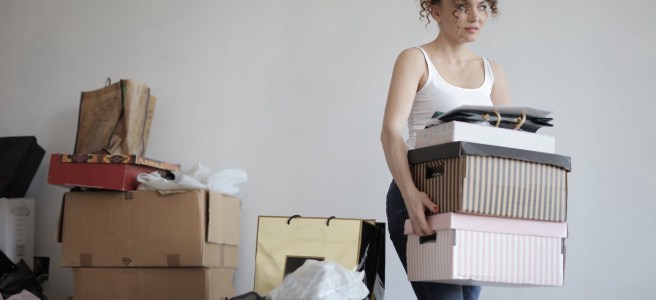
What would you do if you lost all your possessions?
I find these hypothetical questions challenging and interesting. Since my answer is conceptual, I am only imagining how I would be impacted by losing all possessions. Writing about this question has invited deep self-reflection. I discovered some attachments I did not want to admit. Here are the questions that rose in me:
- What is the nature of possessing “things?”
- Are possessing and owning the same thing?
- What are the consequences of possessing something?
- How would my life change with no possessions?
As an optimist, I immediately want to paint the loss of all possessions as a “good” opportunity. However, the reality of losing all possessions is unclear to me in anything but theory.
Possessions
There are any number of items that have come into my possession over my lifetime. There have been gifts, purchases, discoveries, inheritances, and memorabilia. Of these possessions, items attached to memory are the most “meaningful” and challenging to let go.
I think of the books I read to my children, that t-shirt I wore in high school (long ago), rocks and shells from special places. Holding these items transport me to other times and places, to fond (usually) memories, and to feelings and thoughts long gone Somehow I have come to equate the item with the memory. As long as I have that program or album, I conjecture I will not forget the associated event. There may be some truth to that since the body holds memory. Possessions tied to memories would be the most challenging to lose.
Possessions become dangerous for me when I begin to define myself by them; the danger is imagining what I possess (how much and how many and how rare) in some way could ever define me. Wow! How did that happen? When did I start to imagine that stuff could define me?
When I begin to be defined my “my” personal items, I no longer possess the possessions; the possessions possesses me!
I began to be defined by my stuff when I started to receive stuff as mine. It is a Western cultural mindset. Advertisers are constantly reminding me I am not enough, but I could be if I smelled a certain way, wore certain clothing, drove the flashiest vehicle, owned cutting-edge technology, lived in a huge house, and watched the hippest shows on stadium-sized screens. If I possessed all that, only then would I be enough. This leads to defining myself by what I have.
When I begin to be defined by “my” personal items, I no longer possess the possessions; the possessions possesses me! I will do whatever is necessary to secure and protect them, to insure these items ongoing place in my life. When I can no longer see my intrinsic value apart from the extrinsic value of stuff, I have crossed a destructive line.
Ownership versus Possession
Possession is a solid word; possession is to have access to and the use of something. On the other hand, ownership points having more than use of, but exclusive rights to use this property; in that case, the item would be my property.
I wonder about this idea of ownership and the rights ownership implies. While I can embrace the idea of having access to something I need, the concept of controlling property and something belonging solely to me is less attractive. Perhaps the one who most has need of something should be the one to possess it? Who would determine who needs it? Currently, who needs it is often determined by who can afford it; need is determined by market forces rather than any ethical consideration.
Nothing is permanent including this body in which my consciousness resides. I choose to see myself as having possession of this form with the caveat that I provide care of it (and all I possess). This body is a gift and it is the sensory array through which I experience time and space. Thinking of my body as a possession entrusted to my care reduces unhealthy attachment to it; it also reduces the challenge I noted in the first section of coming to be defined by what I possess, even this body.
Understanding items as possessions helps me see that as a caretaker of the item, there may come a time when someone else might benefit more than me from possessing the item in question. Recognizing I have been a caretaker of the item makes passing it along easier.
No Possessions
I am going to make a conjecture: it would be very disorienting to lose all my possessions. It is very sneaky how I have come to build my life around the things in my life. Those possessions are meant to assist me in living, making life easier. However, I also see the more I accumulate, the more I have to curate… and guard. That is not an easier life; it is more complex with each additional possession! Somewhere along the way, possessions became property I own which, in turn, became that which defines me. What a slippery slope! Here I am being possessed by all the things I possess. Here I am shaping my life around maintaining these possessions!
I repeatedly tell others this truth: you are infinitely precious and unconditionally loved for the gift you already are! Perhaps without possessions to definite me,I would hear those words anew for myself…
Losing all my possessions might be the clarion call of freedom. Admittedly, it might be painful at first. Then, I might come to be reminded that what I possess does not define me, contrary to what USAmerican advertisers and the capitalist economic system say. I might even rediscover that I am enough, just me as I am. I repeatedly tell others a truth: you are infinitely precious and unconditionally loved for the gift you already are! Perhaps without possessions to definite me, I would hear those words anew for myself, realize my stuff is not the gift, I am.
At the very least, I am examining these possessions to determine if the time has come for some of it to be passed along someone else. I am simply curating these possessions now; they do not define who I am!
Conclusions
Some possessions are necessary for life. I get to define what it truly needed and what is merely optional. I am finding after consideration that perhaps I have allowed more items to become needs than really are. It is ingrained in our culture and begins when we first receive items we define as our own (own-ership). I struggle in pursuit of the simpler life I imagine would come with fewer possessions. I am not ready to voluntarily go with no possessions but reducing the number would clearly simplify my life. I will continue to work at it, not merely as an idea but as an active work-in-progress!


 Infinitely Precious
That’s a good analysis on this topic.
LikeLiked by 1 person