
There is a kind of silence that heals.
It is the silence we seek when the world has become too loud, too sharp, too demanding. It is the silence of breath and grounding, the quiet that helps us remember who we are beneath the noise of expectation and fear. I speak often about this kind of silence because it matters deeply. Without it, we lose ourselves. Without it, we react instead of respond.
But there is another kind of silence.
It is the silence that allows harm to continue unchecked.
The silence that watches injustice pass by and calls it prudence.
The silence that confuses comfort with peace.
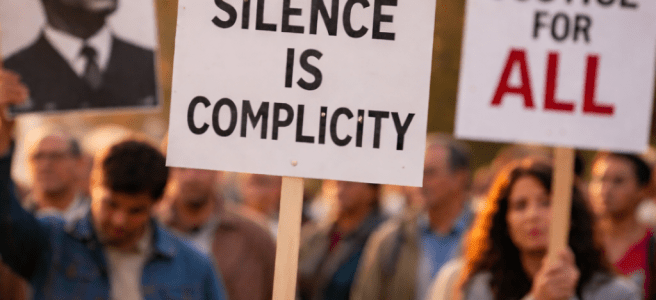
This week, as we marked Martin Luther King Jr. Day, I found myself unsettled by one of his most enduring indictments: “In the end, we will remember not the words of our enemies, but the silence of our friends.” That sentence doesn’t let me rest easily. It shouldn’t. It presses against the softer edges of my spirituality and asks whether my quiet has ever slipped into complicity.
Silence, after all, is not morally neutral. Context matters. Timing matters. Intention matters. There are moments when silence is wisdom—and moments when silence becomes avoidance, fear, or even a tacit endorsement of the way things are.
As a follower of Jesus, I cannot ignore that tension. Jesus practiced solitude. He withdrew to pray. He listened deeply. And yet, when confronted with exploitation, exclusion, and cruelty, he spoke. He challenged. He disrupted. Violence was done to him, but it was never his way. Nonviolence, however, never meant passivity.
We are living in a time when people are discounted—because of the color of their skin, the language they speak, the place they come from, their poverty, their immigration status, or their lack of social power. These are not abstract issues. They are human lives. And when we encounter the mistreatment of any human being, silence ceases to be a spiritual refuge and becomes something far more dangerous.
I recently preached on the phrase from the Lord’s Prayer: “Your kingdom come.” Or, as some translate it, your reign come. That prayer is not passive. It is an invitation—perhaps even a summons. If we are praying for God’s reign of justice, compassion, and belonging, then we must also ask whether we are willing to participate in it. God’s reign looks like kindness. It looks like equity. It looks like a table wide enough for everyone. And it asks something of us.
This does not mean shouting in anger or reacting from rage. Courage rooted in love is different. It grows from deep silence, not shallow outrage. It speaks clearly, peacefully, and persistently. It understands that to stand for what is right may invite resistance, criticism, or even harm—but that the cost of silence is ultimately greater.
Still, I want to say this gently: if silence is all you have right now—if fear, grief, exhaustion, or overwhelm have made speech impossible—grace still holds you. You are not disqualified from love. You are not less precious. Silence can be a necessary beginning.
But let it be a beginning.
Let silence ground you, not excuse you. Let it clarify your voice, not erase it. And when you can—when love stirs courage within you—speak. Advocate. Stand. Say something when you see something, not from fear, but from care.
Because everyone matters.
Because injustice does not correct itself.
Because silence, when misused, speaks loudly.
Above all, remember this: you are infinitely precious and unconditionally loved for the gift you already are. It is from that place—only from that place—that our voices are meant to rise.

 Infinitely Precious
I shall be absorbing your words for days to come, love. My spirit feels blessed in the reading… hugs
LikeLiked by 2 people