
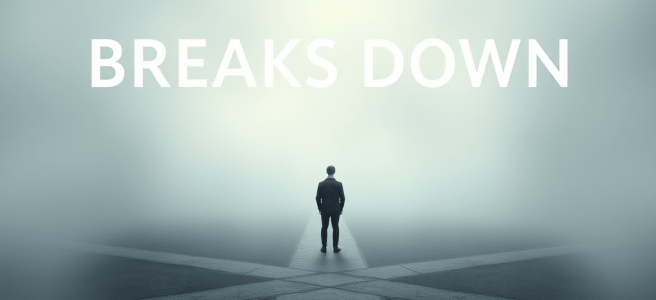
There are moments in life when the ways we have understood ourselves, the world, and even God simply stop working.
The stories that once held us together lose their coherence. The beliefs that once gave us certainty begin to feel thin. The practices that once grounded us start to feel empty or incomplete. And suddenly we find ourselves standing in a strange, disorienting place where meaning itself feels like it is unraveling.
If you have ever found yourself there, you are not alone.
For many of us, faith begins as something received. We inherit language, images, doctrines, and stories that help us make sense of reality. These frameworks can be beautiful and necessary. They give us orientation. They give us a starting place.
But faith, if it is alive, rarely remains static.
As we grow, we learn more about the world. We encounter people who change us. We experience love, loss, disappointment, joy, and wonder. We begin to notice contradictions—both in ourselves and in the systems we once trusted. Slowly, sometimes imperceptibly, our inner landscape begins to shift.
What once felt solid starts to feel less certain.
This can be frightening.
When meaning breaks down, our first impulse is often to rebuild as quickly as possible. We want new answers. New certainties. A new system that will make everything feel stable again. We look for the next book, the next teacher, the next interpretation, the next spiritual technique that promises to put the pieces back together.
But what if this breaking apart is not a failure?
What if it is a necessary threshold?
In the contemplative tradition, there is an understanding that transformation rarely happens through accumulation. It happens through subtraction. Through unknowing. Through the slow loosening of what can no longer carry the weight of who we are becoming.
This is not comfortable work.
Living in between old meanings and new ones places us in liminal space—a threshold where the old has fallen away, but the new has not yet fully taken shape. It can feel groundless, lonely, and disorienting.
And yet, it can also be holy.
A steady contemplative practice—whether meditation, silence, breath prayer, or gentle awareness—does not rush us out of this space. Instead, it teaches us how to remain. How to sit with not knowing. How to breathe without demanding immediate resolution.
Over time, we begin to notice something surprising.
Even as many meanings fall apart, not everything disappears.
Some things remain.
Perhaps a deep sense that love matters.
Perhaps a quiet knowing that compassion is still worth choosing.
Perhaps an intuition that presence itself is meaningful, even when we cannot explain why.
These small, quiet truths may not arrive as grand theological systems. They may not fit neatly into old categories. But they carry a different kind of weight—less rigid, more relational, more alive.
When meaning breaks down, we are invited to ask different kinds of questions:
What still feels real to me?
What still draws me toward tenderness?
What feels life-giving, even in small ways?
Who am I becoming in this season?
These questions do not demand immediate answers. They are meant to be lived into slowly.
There is also a particular grief that can accompany this season—the grief of realizing we cannot go back. We cannot return to earlier versions of ourselves who believed with simpler certainty. We cannot unknow what we now know.
This grief deserves gentleness.
At the same time, there is a quiet freedom hidden inside it.
Letting go of what no longer fits creates space. Space for new language. Space for new images of the divine. Space for a faith that is less about control and more about relationship. Less about certainty and more about trust. Less about having everything figured out and more about learning how to love well.
Sometimes the most faithful thing we can do is not to resolve our doubts, but to stay in conversation with them.
To remain curious.
To remain open.
To remain honest.
If you are in a season where meaning feels thin or absent, I want to offer you this gentle reminder:
You are not broken.
You are not failing.
You are not behind.
You are human.
You are growing.
You are becoming.
And even here—especially here—you are infinitely precious and unconditionally loved for the gift you already are.
Meaning may not return in the way you expect.
It may not arrive as a perfectly constructed belief system.
It may come instead as a deepening capacity for compassion.
As a softer heart.
As a quieter presence.
As a growing willingness to live with open hands.
When meaning breaks down, it is not the end of your story.
It may be the beginning of a truer one.

 Infinitely Precious
Very thought-provoking post. Never consider the subtractive process 🙂
LikeLiked by 1 person