
Forgiveness is one of those words we hear so often that it can start to feel hollow. We’re told it’s important. We’re encouraged to “let it go.” We’re reminded—sometimes gently, sometimes not—that forgiving is good for us and for others. And yet, if we’re honest, many of us have had the experience of forgiving and discovering that… nothing feels fixed.
The hurt is still there.
The trust feels different.
The relationship is changed.
I want to suggest that this doesn’t mean forgiveness has failed.
I’ve come to understand life as deeply relational. We live within a kind of relational field—one animated by spirit, shaped by connection, and infused with the divine. Each of us is a finite expression of something infinite, moving together within this shared field of life.
And within that field, misalignment happens.
Sometimes we fall out of alignment with one another. Sometimes with ourselves. Sometimes with the world as it truly is. Sometimes with the heart’s desire of the divine. When that happens, something real breaks. I can’t find a better word for it than that: something is broken.
And when something breaks, even careful repair leaves marks.
In the resurrection stories, Jesus appears to his friends bearing scars. New life has emerged—but the wounds are still visible. They don’t define him, but they do tell the truth about where he has been. The scars are not erased in the name of healing.
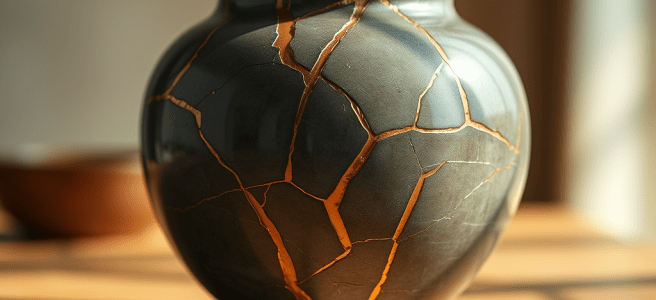
When I think about forgiveness, I often think of kintsugi, the Japanese art of repairing broken pottery with gold. Rather than discarding what is broken, the pieces are carefully rejoined. The cracks are not hidden. They are traced with gold. The vessel becomes something new—whole again, but no longer the same as it once was.
Forgiveness works much the same way.
It does not return us to innocence. It does not rewind the story. It does not make things “as they were before.” Forgiveness repairs—but the repair leaves evidence. The scars remain.
And those scars matter. They shape how we trust. They change how we move forward. They sometimes leave us alert, cautious, aware of what might happen again. The idea that we can simply “forgive and forget” doesn’t ring true to lived experience—and it doesn’t ring true to the sacred stories either.
Forgiveness realigns what was misaligned, but the entire relational field is changed by that realignment. Not just the people directly involved, but the wider web of connection we all share. Even when the change feels small, it is still real.
So when forgiveness feels like it hasn’t fixed anything, it may be because we’re expecting the wrong outcome. We expect restoration without consequence. Healing without memory. Repair without cost.
But forgiveness isn’t about pretending nothing happened.
It’s about choosing not to let what happened define who we are.
This isn’t theoretical for me. It’s how I experience the world I live in—the way I swim through this ocean of spirit, aware of how deeply our actions ripple outward. We see those ripples clearly in the fractures of our society: dehumanization, domination, fear, and the temptation to treat the world as something to be mastered rather than honored as sacred.
In the face of all that, letting go matters.
Letting go is not just a practice of forgiveness toward others. It’s a practice of releasing what controls us, shapes us, or hardens us. Letting go again and again. Opening the hand. Choosing not to cling.
And even though forgiveness does not make everything perfect—and does not always lead to reconciliation—the repair is still worth doing.
Mistakes are part of how we learn. Failure can teach us. Misalignment, followed by repair, can shape a wiser, more compassionate way of being in the world. The field may be changed—but so are we.
So don’t give up.
If forgiveness feels hard, incomplete, or ineffective, you’re not failing. If reconciliation isn’t possible, you’re not wrong. Forgiveness doesn’t excuse harm, erase consequences, or demand perfection.
It simply begins the work of repair.
And through all of it—through the scars, the learning, the letting go—never forget this truth:
You are infinitely precious.
You are unconditionally loved.
For the gift you already are.

 Infinitely Precious